
It’s heart-wrenching to see your pup yelp or snap at thin air. If you’re wondering why is my dog acting like something is poking him, you are likely witnessing intermittent sharp sensations caused by anything from static to spinal nerves.
Last month, I dealt with a case involving a Beagle named Cooper. Out of nowhere, he would yelp and snap at his back as if a bee had stung him. His owners were frantic, thinking it was a neurological collapse. After a thorough check, we realized it was ‘Static Shock’ caused by a new synthetic rug and dry indoor air. This experience reminded me how often these ‘phantom pokes’ are caused by simple, fixable environmental triggers.
Have you ever felt a sudden ‘zap’ or a sharp pinch out of nowhere? In humans, we call this paresthesia. When your dog is acting like something is poking him, he is likely experiencing a similar neurological misfire. Instead of a calm afternoon, your pet is suddenly snapping at their flank or jumping away from an ‘invisible needle.’
I’ve seen this countless times in clinical settings. A client once brought in a Jack Russell who would leap off the sofa as if he’d sat on a tack. It wasn’t a prank; it was a localized nerve irritation. In 2026, we’ve realized that these intermittent sharp sensations are often the body’s ‘alarm system’ going off without a cause.
To understand why is my dog acting like something is poking him, we have to look at how a dog’s nervous system and skin react to sudden, sharp changes. Often, what looks like a poke is actually an internal nerve misfire.
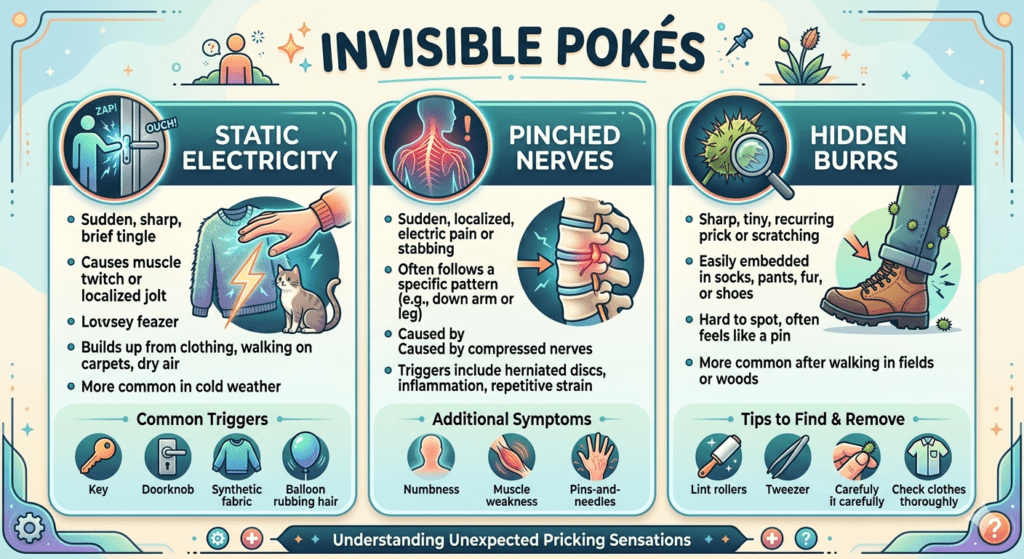
Canine Hyperesthesia Syndrome (CHS): This is more than just an itch. It’s a neuro-dermal disorder where the skin becomes hypersensitive to even the slightest tactile stimuli. You’ll notice localized skin twitching or a ‘rolling’ motion along the back.
Spinal Nerve Impingement: Often, a pinched nerve or disc compression sends a sharp, electric-like shock down the limbs. This neuropathic pain can feel exactly like a sharp jab.If these ‘poking’ sensations are followed by physical weakness or stumbling, it’s crucial to check if your dog’s back legs are giving out, as this could be a sign of a more serious disc compression or IVDD.
Muscle Fasciculations: These are involuntary muscle contractions (twitches) that can startle a dog. If your dog is acting weird after a walk, it might be physical exhaustion causing these spasms.
Micro-Irritants & Foreign Bodies: Never rule out physical objects. Tiny cactus spines, foxtails, or even static discharge from synthetic fabrics can mimic a poke.
I remember working with a Beagle named Buster who suffered from these ‘invisible pokes.’ His owners thought it was behavioral, but after a closer look, we realized it was nerve root irritation triggered by his harness. By switching to a pressure-free vest and improving his joint health with 2026-standard supplements, the ‘poking’ stopped. The takeaway? Always look at the physical triggers before assuming it’s just ‘anxiety’.
Pro-Tip from Experience: I once dealt with a Beagle named Cooper who would jump as if he’d been pricked by a needle every time he walked on a synthetic rug. We realized it was simply Static Electricity build-up in his fur. If your dog acts this way, try using a humidifier or a natural-fiber pet bed to see if the ‘pokes’ disappear.
If you want to help your vet, monitor these specific behavioral markers:
Check for Allodynia: Does a normal touch (like petting) cause a painful reaction?
Observe the Tail: Is the dog chasing its tail or biting the base? This often points to sacral nerve issues.
Evaluate the Environment: Are these ‘pokes’ happening near electronic devices or on specific rugs? Static electricity is a major environmental trigger in modern homes.
When a dog acts like something is poking him, it’s a sign that his peripheral nervous system is sending a distress signal. Whether it’s nerve-related discomfort or a simple static shock, early intervention is key.
If the poking sensation is accompanied by physical weakness, check our guide on dog’s back legs giving out.
If your dog is avoiding certain areas of the house, they may be scared of the floor due to past shocks.
For a deeper technical dive into how nerves affect movement and sensation, you can explore the Merck Veterinary Manual on Canine Neurological Disorders, which remains the gold standard for pet health reference in 2026.
Yes. Medically known as paresthesia, dogs can experience tingling, buzzing, or “poking” sensations. This is usually caused by nerve irritation, localized skin sensitivity, or even environmental factors like static electricity.
While it can be startling, “air snapping” is often a reaction to a sudden tactile stimulus. If your dog acts like they were bitten by an invisible insect, check for Canine Hyperesthesia or localized nerve shocks.
If the “poking” sensation is accompanied by localized skin twitching, constant yelping, or if you notice your dog’s back legs are giving out, you should seek a professional neurological evaluation immediately.
Absolutely. In dry, cold weather, static electricity builds up in a dog’s fur, especially if they use synthetic bedding or walk on carpets. This can cause a sharp, needle-like discharge that confuses the dog.