
Is it illegal to leave your dog in the car? Learn about state hot car statutes, Good Samaritan laws, right-to-rescue rules, and the severe penalties for pet owners.
Many pet parents enjoy taking their dogs along for errands, but parking the car to quickly step into a store poses significant legal and physical dangers.
The short answer is yes, leaving your dog in a car can be highly illegal depending on your location, the outside temperature, and the duration. In many regions, doing so crosses the line from a simple oversight into a criminal misdemeanor or felony animal abuse charge due to how rapidly an enclosed vehicle can become a lethal thermal chamber.
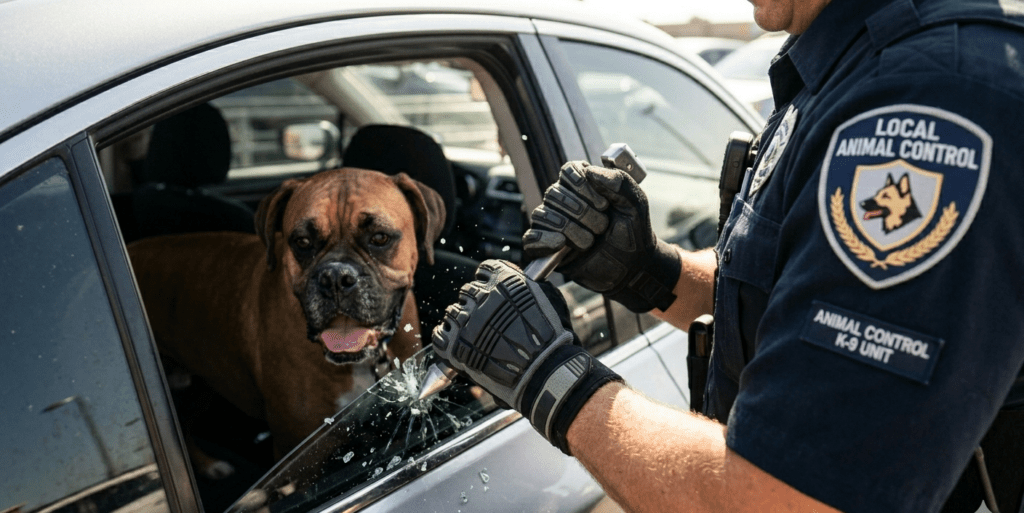
I once assisted a veterinary forensic team with a case involving a young Boxer named Max. His owner had left him in a parked vehicle with the windows cracked for “just fifteen minutes” while stepping inside a post office on an apparently mild 26°C (79°F) afternoon.
The Reality: Within that short window, the car’s interior temperature crossed 40°C (104°F).
The Impact: Max suffered acute heat exhaustion.
The Rescue: A passing bystander alerted law enforcement, who shattered the window to rescue him.
The Outcome: Max survived after intensive emergency therapy, but his owner faced hefty criminal fines and a formal citation for animal endangerment.
Animal welfare laws differ heavily by state and country, split primarily between specific vehicle-focused regulations and broader anti-cruelty frameworks.
A major area of legal evolution involves Civil Immunity Laws, which dictate whether a civilian can legally damage a vehicle to rescue a trapped animal.
The legal defense of “leaving the windows cracked” is routinely rejected by courts because it ignores basic thermodynamic principles.
Modern electric vehicles (EVs) often feature specialized software settings, such as Tesla’s “Dog Mode,” which allow the car’s air conditioning system to remain active while the vehicle is parked and locked, displaying the internal temperature prominently on the central dashboard screen. While this technology generally keeps pets safe, it is still technically illegal in certain strict jurisdictions that penalize leaving any animal unattended in a vehicle regardless of the internal climate control status. Always research your local town ordinances before relying entirely on EV climate tech.
There is no universally safe temperature, but danger risks escalate sharply once ambient outdoor temperatures reach 21°C (70°F) or higher. On a mild 21°C day, a car’s interior can quickly skyrocket to a lethal 32°C (90°F). In freezing conditions, cars can act as refrigerators, making it equally illegal to leave a dog exposed to hypothermia risks.
Active signs of emergency distress include extremely heavy or loud panting, thick or excessive drooling, bright red or purple gums, vomiting, glassy eyes, unsteadiness on their feet, disorientation, or complete unresponsiveness. If a dog displays these symptoms, they are entering a lethal stage of hyperthermia.
If your jurisdiction has active Good Samaritan civil immunity laws and you followed the legal steps (such as calling 911 first), you are legally protected from civil lawsuits. If your state lacks these explicit laws, the vehicle owner could technically file a claim for property damage, though public policy and anti-cruelty defenses often favor the rescuer in court.
In many regions, yes. Many municipalities have strict anti-idling laws that make it illegal to leave an engine running unattended. Furthermore, mechanical failures can occur—an engine can stall, or the air conditioning can malfunction—rapidly cutting off the cool airflow and turning the vehicle into a death trap while you are away.
Leaving your dog in a parked car is a high-risk gamble that carries severe legal penalties and devastating physical consequences. By shifting your perspective, planning pet-free grocery runs, and understanding the explicit hot car statutes within your specific jurisdiction, you can keep your animal companion safe and avoid costly criminal citations. For authoritative, up-to-date legislative tracking on animal vehicle confinement laws across various regions, explore the Animal Legal & Historical Center state statutory compilation.