
If your dog comes back from a walk pacing, panting, or hiding, you’re likely panicking. Understanding why is my dog acting weird after being outside is the first step to ensuring their safety from heat stroke, allergies, or sudden fear.
Coming back from a walk should be the highlight of your dog’s day, but if they return home pacing, panting, or hiding, it can be deeply concerning. Most owners assume their dog is just tired, but sudden behavioral shifts often signal a hidden physical or emotional trigger.
I remember a neighbor’s dog, Rocky, who came back from the backyard and immediately crawled under the sofa. We thought he was just exhausted from the heat, but upon closer inspection, we found a tiny burr (thorn) wedged deep between his paw pads. Even a small physical discomfort can make a dog act completely out of character.
Many lawns are treated with pesticides, fertilizers, or herbicides that can cause paresthesia—a “creepy-crawly” or tingling sensation on a dog’s skin.
The Connection: This skin irritation is very similar to the reaction some pets have to topical medication. If your pet is frantic, they may be experiencing a sensation like a dog acting weird after flea treatment.
What to do: Thoroughly wash your dog’s paws and underbelly with lukewarm water and a pH-balanced pet shampoo to remove botanical allergens or chemical residue.
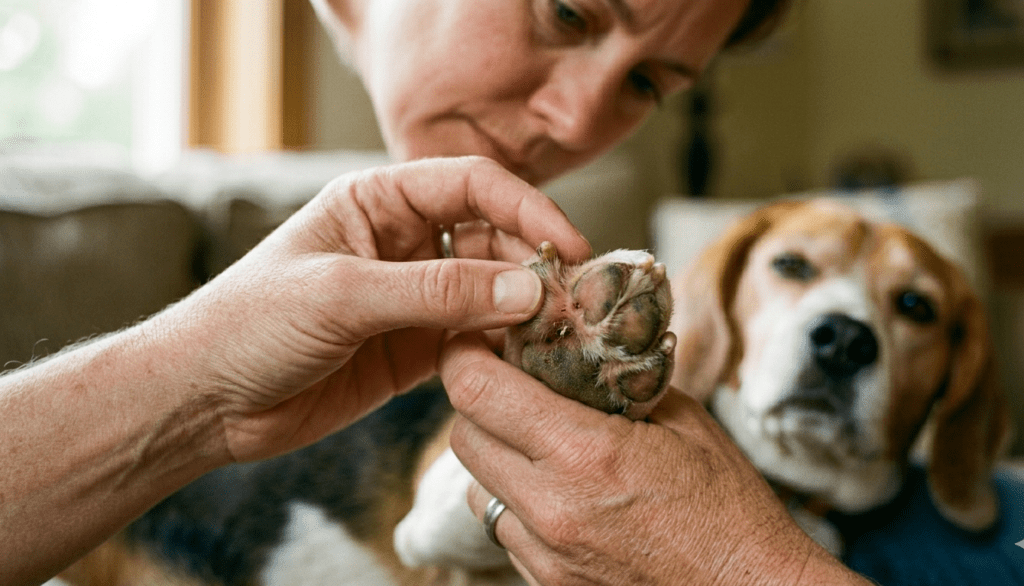
Hymenoptera stings (bees, wasps) or spider bites aren’t immediately visible under thick fur. A sudden “fear spike” or hiding behavior is often a response to acute localized pain.
Check for Inflammation: Look for “hot spots,” raised bumps, or hives (urticaria) on the muzzle and paws.
Sensory Overstimulation: If your dog is twitching or snapping at the air, it could be a nerve response similar to the feeling of something poking them.
With rising temperatures, hyperthermia can happen in as little as 10 minutes. Dogs rely on panting for thermoregulation, and if they can’t cool down, their behavior will change rapidly.
Signs of Distress: Bright red mucous membranes (gums), excessive thick drool, and ataxia (a “drunken” walk).
Internal Link: If your dog’s legs look weak or wobbly after being in the sun, you must rule out serious issues like their back legs giving out, which can be triggered by heat-induced fatigue.
Sometimes, the sensory triggers of the outdoors (loud noises, strange scents) lead to a compulsive behavioral disorder.
Oral Fixation: If your dog comes inside and begins frantically licking the floor or their paws, it may be a sign of gastric distress from something they scavenged outside.
Helpful Resource: For more on this specific habit, read our guide on a dog licking floor obsessively.
| Symptom | Immediate Step | LSI Keyword Connection |
| Panting / Red Gums | Move to AC; offer cool water. | Thermoregulation |
| Hiding / Shaking | Perform a “Nose-to-Tail” check. | Acute Pain Response |
| Frantic Scratching | Rinse coat to remove chemicals. | Contact Dermatitis |
| Lethargy / Weakness | Check hydration and gum color. | Dehydration/Ataxia |
Most dogs will settle down within 20 to 60 minutes once they are back in a safe, familiar environment. However, if the fear was caused by a loud noise like a firework, they may remain clingy or anxious for several hours. Providing a quiet “safe zone” or crate can speed up recovery.
Yes, absolutely. Botanical allergens or lawn chemicals can cause immediate contact dermatitis (skin irritation). This often leads to frantic scratching, rolling on the carpet, or obsessive paw licking. A quick rinse with cool water usually provides instant relief.
If your dog’s panting doesn’t slow down after 10 minutes of rest in a cool room, or if their gums look dark red or purple, it is a medical emergency. This is a sign of hyperthermia (heat exhaustion), and you should contact a vet immediately.
Hiding is a classic sign of acute pain or sensory overload. Your dog might have a hidden insect sting, a thorn in their paw, or they might have been spooked by something you didn’t notice, like a high-pitched sound or a neighbor’s dog.
When you ask, “Why is my dog acting weird after being outside?” you are usually dealing with a physical reaction to the environment. Always trust your gut—if the behavior doesn’t settle within 30 minutes of rest, a vet visit is necessary to rule out anaphylaxis or internal injury. For more on outdoor safety, you can check the Humane Society’s Guide.