Master the art of in-home dog training with our step-by-step guide. From puppy basics to correcting behavioral issues, discover expert techniques to transform your dog’s obedience in the comfort of your home.
Training your dog doesn’t require an expensive bootcamp or an outdoor arena. In fact, because most behavioral issues occur where your dog feels most comfortable, the home is the absolute best environment to establish boundaries. By understanding canine psychology and applying consistent training principles, you can transform your dog’s manners right from your living room.
I once worked with a rescue mix named Maximus who had severe boundary issues. He would jump on counters, bark at the window, and completely ignore his owner’s commands. His owners thought they needed a professional facility, but by implementing just ten minutes of structured, distraction-free training inside their hallway every evening, Maximus learned to focus. Within three weeks, he went from a chaotic pet to a focused, well-mannered companion.
The foundation of in-home dog training relies on setting clear rules that every family member enforces. Dogs thrive on predictability; when rules change depending on who is watching them, behavioral confusion sets in.
The Power of “Place”: Teaching your dog to go to a designated mat or bed gives them a constructive alternative to unwanted behaviors like begging or rushing the front door.
The Clingy Companion: Establishing boundaries also helps prevent hyper-attachment. If you don’t set spatial rules, you might find yourself wondering why does my dog follow me everywhere, which is often a symptom of a “Velcro dog” lacking independent confidence.
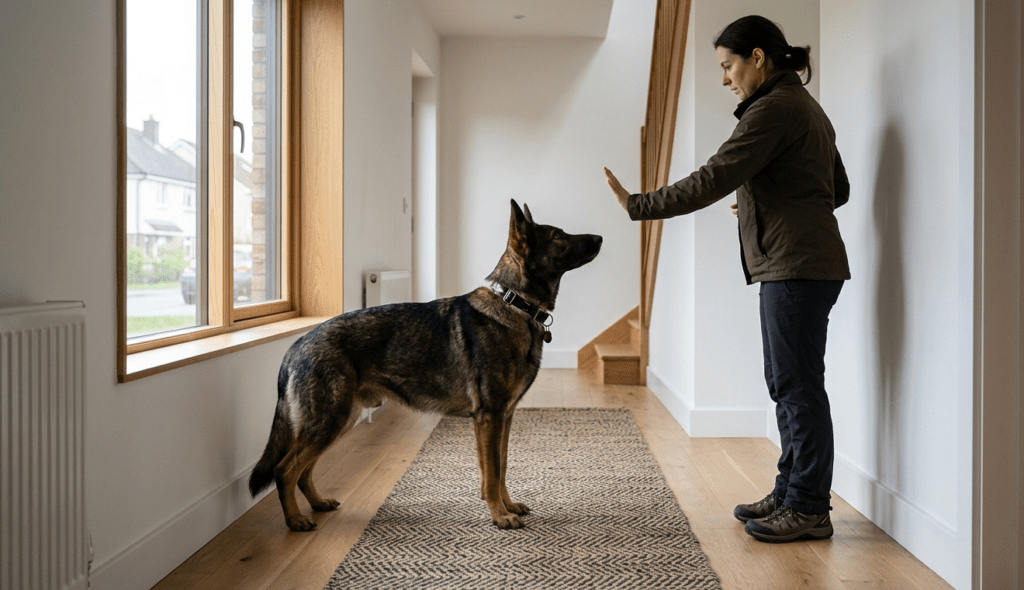
Before you can modify a behavior, you must manage the environment to prevent your dog from practicing the bad habit. If a dog repeats an unwanted behavior successfully, it becomes self-rewarding.
Managing Small Spaces: Environmental management is crucial if you live in tight quarters. When looking for the best way to potty train a puppy in an apartment, success depends entirely on crate management and blocking access to carpeted areas before the puppy is fully trustworthy.
Handling Compulsive Habits: A controlled environment also makes it easier to spot stress signals. For example, if a dog feels overwhelmed by changes in the household, they might display displacement habits, such as when a dog keeps licking carpet after eating to soothe their nervous system.
One of the most critical aspects of home safety is addressing Resource Guarding. This occurs when a dog becomes defensive over food, toys, or specific sleeping spots.
The Trade-Up Game: Never forcibly take an item away from your dog, as this reinforces their fear that you are a threat to their resources. Instead, teach them to “drop it” by offering a treat of higher value.
Dietary Boundaries: This approach is vital when introducing high-value items to their routine. For instance, when owners decide to see if can dogs eat raw chicken bones, they must supervise the session carefully to ensure the dog doesn’t become overly protective or aggressive with the prize.
Many owners fail at in-home training because their sessions are too long, causing the dog to lose focus and become frustrated. A dog’s brain absorbs information best in short, high-energy bursts. Keep your training sessions under two to three minutes, but repeat them three times a day. End every session on a successful note with a jackpot reward so your dog looks forward to the next lesson.
Use classical counter-conditioning. Keep a bowl of treats nearby, and the moment your dog looks at the window before they start barking, mark the quiet behavior with a click or a “yes!” and give them a treat. You are rewriting their emotional response to the trigger.
Absolutely. The old saying “you can’t teach an old dog new tricks” is anatomically incorrect. Senior dogs have great focus and enjoy the mental stimulation, though you must adjust physical expectations based on their joint health.
Repeating a command over and over (e.g., “Sit, sit, sit”). If you repeat the word, your dog learns that they don’t have to listen the first time. Say the command once; if they don’t comply, gently guide them into position or remove the reward opportunity.
Clickers are excellent because they offer an exact Event Marker that tells the dog precisely which movement earned the treat. However, a consistent verbal marker like “Yes!” works just as well if your timing is accurate.
Mastering your dog’s behavior at home doesn’t require complex equipment—it requires consistency, clear marker signals, and a thorough understanding of what motivates your pet. By transforming daily routines into mini-training opportunities, you create a harmonious household built on mutual respect. For more scientifically verified behavioral guidelines, review the Association of Professional Dog Trainers (APDT) resource library.