
Is your dog struggling when you’re away? Discover how to help a dog with separation anxiety through proven training methods, calming tools, and expert advice from PetBehaviors.
Separation anxiety is far more than a minor case of a dog missing their owner; it is a clinical panic disorder. When a dog suffering from this condition is left alone, they experience a severe physiological “fight-or-flight” response. This panic often manifests as destructive chewing near exit points, non-stop howling, pacing, or self-harm. Understanding how to systematically unpack this anxiety is essential to restoring peace to your home and confidence to your dog.
I remember working with a rescue German Shepherd named Barnaby who would literally tear through drywall whenever his owner left for work. His owner felt trapped in their own home, unable to leave for even a grocery run. By using gradual departures, breaking his pre-departure cues, and building his independent confidence, we managed to lower Barnaby’s panic threshold. Within two months, he was able to snooze comfortably on his bed for up to four hours alone.
Many owners confuse simple boredom with true separation anxiety. The key differentiator is the timeline and the intensity of the behavior.
The Panic Timeline: Separation anxiety behaviors almost always occur within the first 15 to 30 minutes of your departure.
Pre-Departure Triggers: Dogs with this condition are masters of observation. The moment you pick up your keys, put on your shoes, or grab your coat, their heart rate spikes. They begin panting, whining, or shadow-following you frantically.
The “Velcro” Behavior: This constant shadowing is a major warning sign. If you don’t address this clinginess early on, it can evolve into severe hyper-attachment, leaving you frustrated and wondering why your dog is exhibiting obsessive habits around the house.
The most effective way to treat separation anxiety is to slowly change your dog’s emotional response to being alone through gradual exposure.
Deconstructing Pre-Departure Cues: Pick up your keys, sit on the couch, and watch TV. Put on your coat, but go make dinner. By repeating these actions without actually leaving the house, you break the association between the cue and the panic.
Gradual Departures: Step outside your front door for just two seconds, then walk back in before your dog panics. Slowly increase this time to 5 seconds, 30 seconds, 2 minutes, and eventually 15 minutes.
The Routine Reinforcement: Building this independence takes the same level of patience and structural setup you would use when implementing general in-home dog training tips. Consistent, short sessions are the secret to success.
Anxiety rarely lives in a vacuum. A dog whose nervous system is already hyper-reactive will be far more susceptible to minor environmental changes.
Symptom Overlap: Separation anxiety often goes hand-in-hand with other phobias. For instance, if your dog is scared of thunder, a mild rainstorm while you are away can cause a massive behavioral regression, triggering intense panic attacks.
The Cross-Species Effect: Household stress can travel between different pets in unexpected ways. If your dog is howling and crashing against doors downstairs, the chaos will easily spike the anxiety levels of your other animals. This environmental tension can directly cause your feline companions to act out, leading to issues like trying to train a cat to stay off counters as they seek high vertical safety away from the panicking dog.
The way you leave and return to your home heavily dictates your dog’s anxiety levels. If you give your dog dramatic, emotional goodbyes, you confirm their fear that your departure is a major, dangerous event. Likewise, if you throw a massive party the moment you walk through the door, you make the return highly anticipated, increasing their anxiety while you are gone. Ignore your dog for 5 minutes before you leave, and ignore them for 5 minutes when you return. Only interact with them once they are completely calm.
Rarely. Separation anxiety is typically an attachment to you, the human, not just a fear of being alone. Bringing a second dog into the house often results in you having one dog with panic attacks and a second dog who learns to mirror the anxious behavior.
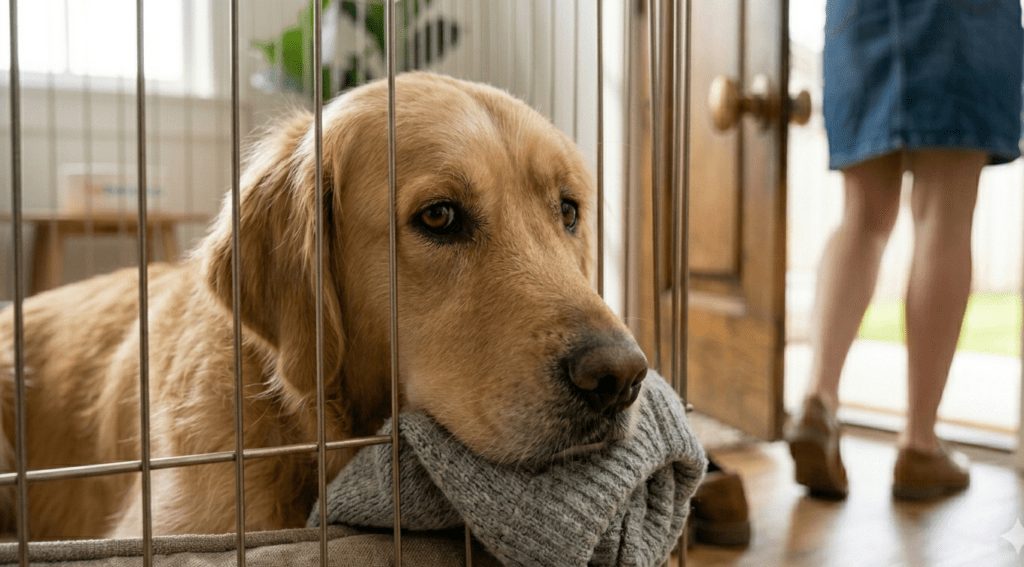
Use caution. Dogs with true separation anxiety often develop Crate Phobia during a panic episode. They may break their teeth or nails trying to chew out of the wire mesh. If your dog panics inside a crate, it is safer to confine them to a dog-proofed room using a sturdy baby gate.
They can help with mild isolation distress, but a truly panicked dog will completely ignore food. If you leave a frozen Kong and return to find it untouched—only for your dog to eat it the second you get home—their anxiety threshold is too high for simple distractions.
If your dog is injuring themselves (bleeding paws, broken teeth) or if your desensitization progress is stuck at the 2-minute mark, talk to your vet. Selective Serotonin Reuptake Inhibitors (SSRIs) like Fluoxetine can lower their baseline panic so that behavioral training can actually take hold.
Overcoming separation anxiety is a marathon, not a sprint. It requires shifting your mindset from managing “bad behavior” to treating a genuine clinical panic attack. By utilizing structured desensitization, keeping your departures low-key, and working alongside veterinary behaviorists if necessary, you can help your dog find their independence. For professional, step-by-step separation protocols, consult the Certified Separation Anxiety Trainers (CSAT) directory via Malena DeMartini.